The rolling capacity of a W12 4-roll plate rolling machine is one of the most critical parameters in equipment selection and production planning. It determines the maximum plate thickness and width that the machine can roll under specific conditions.
Accurate calculation requires understanding material properties, machine structure, rolling force, and bending mechanics. This guide provides a professional explanation of how to evaluate rolling capacity in real industrial scenarios.
What Is Rolling Capacity?
Rolling capacity refers to:
The maximum thickness and width of a metal plate that a rolling machine can bend to a specified minimum diameter under standard working conditions.
It is typically expressed as:
- Max rolling thickness (mm)
- Max pre-bending thickness (mm)
- Max rolling width (mm)
- Minimum rolling diameter (mm)
Key Parameters Affecting Rolling Capacity
1. Material Yield Strength (
)
Material strength is the most important factor.
Typical values:
- Mild steel: ~235 MPa
- Stainless steel: ~520–700 MPa
- High-strength steel: >700 MPa
Higher yield strength = lower rolling capacity
2. Plate Thickness (t)
Rolling force increases exponentially with thickness.
- Doubling thickness increases required force significantly
- Machine capacity is usually rated based on mild steel
3. Plate Width (W)
Wider plates require:
- Higher total rolling force
- Greater machine rigidity
4. Minimum Rolling Diameter (D)
Smaller diameters require higher deformation force.
Relationship:
- Smaller diameter → higher required rolling force
- Larger diameter → easier rolling
5. Roll Diameter and Geometry
For W12 machines:
- Larger roll diameters improve capacity
- Better support reduces deformation loss
6. Machine Structure and Hydraulic Force
The rolling capacity is ultimately limited by:
- Hydraulic cylinder force
- Frame rigidity
- Roll material strength
Basic Rolling Force Calculation Formula
The rolling force can be estimated using bending theory:
Simplified Formula:

Where:
- F = Required rolling force
- C = Coefficient (depends on machine type, typically 1.2–1.5 for 4-roll machines)
- σs = Yield strength of material (MPa)
- W = Plate width (mm)
- t = Plate thickness (mm)
- D = Minimum Rolling Diameter (mm)
Engineering Interpretation
From the formula:
- Rolling force ∝ thickness² → thickness is the dominant factor
- Rolling force ∝ yield strength → stronger materials reduce capacity
- Rolling force ∝ width → wider plates need more force
- Rolling force ∝ 1/D → smaller diameters are harder to roll
Practical Calculation Example
Given:
- Material: Mild steel (σs = 245 MPa)
- Plate thickness: 20 mm
- Plate width: 2000 mm
- Target diameter: 1000 mm
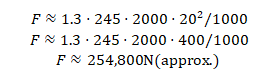
Estimation:

The machine must provide at least this level of rolling force.
Rated Capacity vs Actual Capacity
Manufacturers typically specify capacity under standard conditions:
Rated Condition:
- Material: Mild steel (245 MPa)
- Rolling diameter: ≥ 20 × plate thickness
Real-World Adjustments
| Factor |
Impact on Capacity |
| Stainless steel |
Reduce by 30–50% |
| High-strength steel |
Reduce by 50–70% |
| Smaller diameter |
Reduce capacity |
| High precision requirement |
Reduce capacity |
Pre-Bending Capacity vs Rolling Capacity
For W12 4-roll machines:
- Rolling capacity = maximum thickness for full rolling
- Pre-bending capacity = typically 70–80% of rolling capacity
Example:
- Rolling capacity: 20 mm
- Pre-bending capacity: ~14–16 mm
Advantages of W12 Machines in Capacity Utilization
W12 4-roll machines offer:
- Better force distribution
- Continuous plate clamping
- Reduced energy loss
- Higher effective utilization of hydraulic force
This means actual usable capacity is closer to rated capacity compared to 3-roll machines.
How to Select the Right W12 Rolling Machine
Step 1: Define Material
- Type (carbon steel, stainless, alloy)
- Yield strength
Step 2: Determine Plate Specifications
- Thickness
- Width
- Required diameter
Step 3: Apply Safety Margin
Recommended:
- Add 20–30% capacity margin
Step 4: Match Machine Specification
Choose a machine where:
- Rated capacity ≥ required capacity × safety factor
Why Accurate Capacity Calculation Matters
Incorrect selection can lead to:
- Machine overload
- Poor rolling quality
- Increased wear and maintenance
- Production inefficiency
Proper calculation ensures:
- Stable operation
- Longer machine life
- Better product quality
Why Choose ZYCO W12 4-Roll Rolling Machines?
Modern ZYCO W12 4-roll plate rolling machines are engineered for high-performance applications:
- High hydraulic force output
- Optimized roll geometry
- Advanced CNC control systems
- Stable frame structure
- High precision and repeatability
These features ensure maximum utilization of rolling capacity and consistent production results.
Conclusion
Calculating the rolling capacity of a W12 4-roll rolling machine requires a comprehensive understanding of material properties, plate dimensions, and mechanical principles.
The key takeaway:
Rolling capacity is primarily determined by material strength, plate thickness, and rolling diameter, with thickness having the greatest impact.
For manufacturers and engineers, selecting the right machine based on accurate calculations is essential for efficient, safe, and high-quality production.